
On June 19 2025, the Netherlands Scientific Climate Council (WKR) published its advisory report about climate adaptation. In this advisory report, the WKR elaborates on the critical decisions that are needed in the field of climate adaptation and makes recommendations for the National Climate Adaptation Strategy (in Dutch: NAS), which will be reassessed in 2026. According to the WKR, decisions need to be made in two areas to make and keep the Netherlands climate resilient: spatial and societal.
A new climate reality
The Netherlands must adapt to advancing climate change. It is becoming drier, wetter, and hotter. The climate is changing faster than previously expected and is causing more extreme weather conditions now and in the future: extreme heat, heavy rainfall, and longer periods of drought. There will be shortages of fresh water and sea level rise off the Dutch coast will accelerate. This will increase the risk of flooding and salinization in coastal areas.
These climate risks are accumulating and can also reinforce each other, which means that the total impact may be greater and different than expected. For example, there may be extreme precipitation, high river discharges, and a storm off the coast at the same time, preventing water from draining properly and threatening flooding. The Netherlands must prepare for these risks and adapt to a rapidly changing reality.
Spatial decisions: transform or intensify
There are technical, financial, spatial, and social limits to adaptation. As these limits become increasingly apparent, we will have to make critical decisions more often. In terms of space, this translates into choosing where to intensify the current adaptation approach and where and when to opt for transformation. In the case of intensification, the function of an area remains essentially the same and more measures will be needed to keep it that way: the current protection against climate risks needs to be intensified. This intensification can be limited, such as the smart ‘flushing’ of polders to prevent salinization, or very drastic, such as closing off access to the sea.
Although intensification may be desirable or necessary in some areas, this strategy is not sustainable everywhere in the face of ongoing climate change. This may be due to increasing costs and physical or spatial constraints, such as a lack of fresh water or space for water storage and drainage. In some areas, therefore, transformation is necessary: the function and land use of the area must be adapted to better suit the natural water and soil system, thereby growing along with the changing climate. Transformation means a structural adjustment in an area, creating space for new functions. The WKR recommends four decisions to be made:
- Determine at the national level which areas need to be transformed now. Work this out at the regional level. Start in places where the urgency is greatest: in salinizing clay areas, drying sandy areas, declining peat meadow areas, and warming cities.
- For major investments, such as infrastructure, housing, and industry, conduct a climate adaptation assessment that looks at least 100 years ahead. What we build now will determine the adaptation challenge in the future.
- Create more space for public funding of adaptation to enable the transformation of areas. For example, to create more space for rivers and more cooling greenery in the city.
- Ensure that the costs of adaptation in area development are not passed on to society.
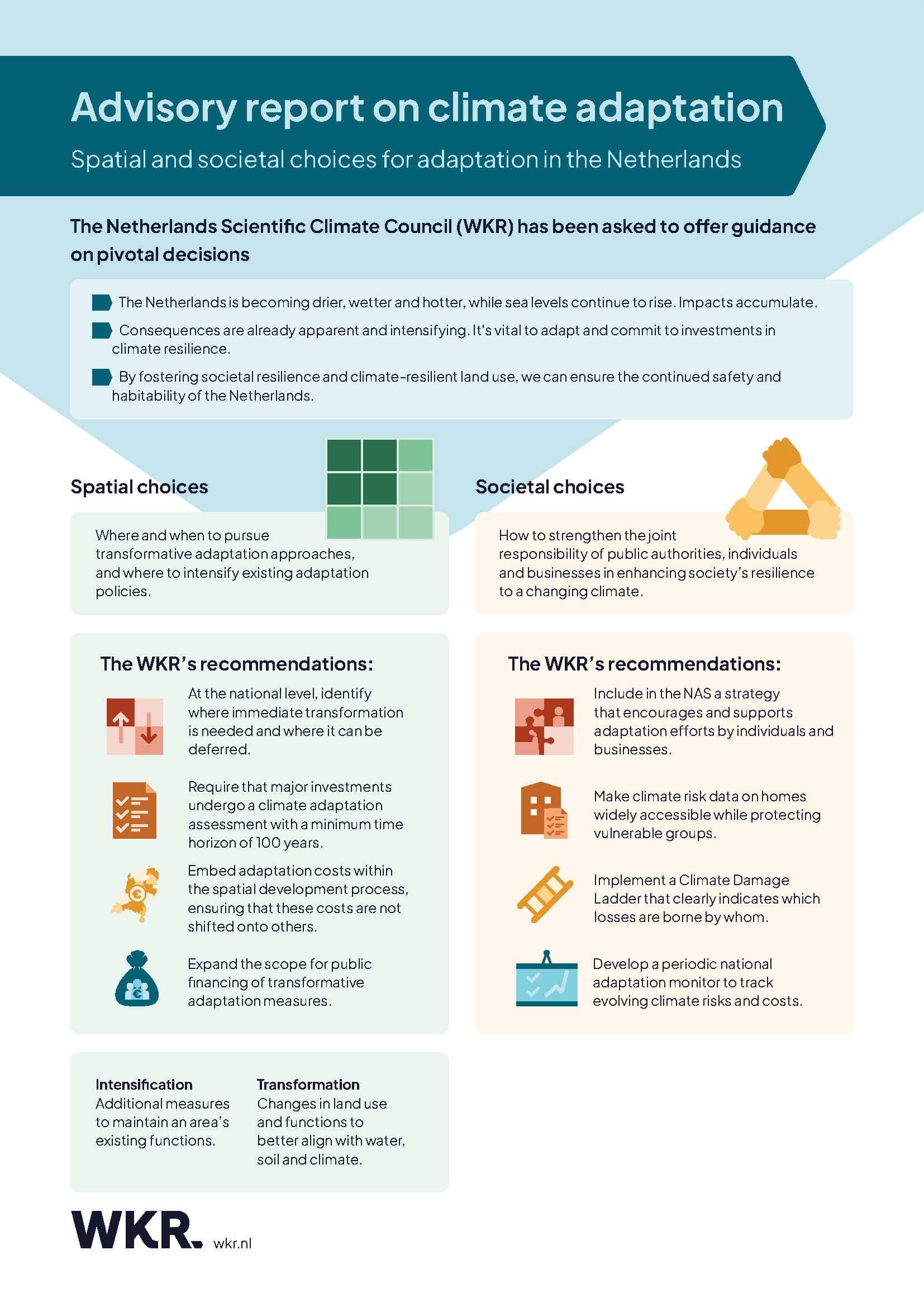
Image: © WKR
Societal decisions: a responsibility of government, citizens, and businesses
Even if we design our space to be climate-proof, we will not be able to prevent citizens and businesses from having to deal with climate extremes more often. After all, flood defenses, dikes, and water buffers can limit the consequences of climate risks, but they cannot prevent them entirely. It is therefore important for citizens and businesses to become more resilient, especially to risks such as drought, heavy rainfall, and heat. The good news is that more and more citizens and businesses are already taking action to adapt to the climate. This is called ‘autonomous adaptation’. It is essential for society to become more resilient in the face of increasing climate risks.
However, without proper coordination, adaptation by citizens and businesses can lead to problems, for example because they get in each other's way, pass on adverse consequences to others, or conflict with government measures. For example, irrigation by farmers during droughts may be a good solution for the individual farmer, but at the collective level it can lead to problems with the drinking water supply.
According to the WKR, policy is needed to ensure that the actions of citizens and businesses contribute to collective resilience. To this end, the WKR recommends four decisions:
- Encourage and coordinate adaptation by citizens and businesses in a way that ensures that everyone becomes resilient and is enabled to participate.
- Make information about climate risks to homes accessible to everyone. This will enable people to make better choices and allow banks and insurers to take these risks into account in a responsible manner. Protect vulnerable groups from unintended consequences.
- Make it clear to everyone who bears which climate risks and when, using a ‘climate damage ladder’.
- Develop a national adaptation monitor to provide insight into risks, measures, and social effects - now and in the future.