
In July 2025, the Netherlands Scientific Climate Council (WKR) published its advisory report about climate vision. In this report, the WKR elaborates on how a vision for a climate-neutral and climate-resilient society contributes to consistent long-term climate policy. The WKR observes that climate goals are slipping out of reach, that current climate policy is too focused on the short term, and that there is a loud call in society for perspective and guidance. To address this, the government should come up with a Climate Vision, the WKR argues in its advisory report.
A Climate Vision as part of the climate policy cycle
The WKR recommends drawing up a Climate Vision that provides direction for the design, implementation, and evaluation of climate policy. Ideally, this Climate Vision should be drawn up prior to the Climate Plan, which is adopted every five years and outlines policy for the next ten years. The drafting and recalibration of this Climate Vision will be included in the climate policy cycle.
In order to contribute to long-term climate policy, this Climate Vision must meet three criteria:
- Long-term time horizon: a strategy for the future presents a vision of society at least 25 years ahead, based on a perspective extending at least 100 years into the future, and facilitates key strategic decisions in the here and now.
- Coherence: a strategy for the future utilises opportunities and resolves conflicts between mitigation and adaptation goals and between climate goals and other policy goals
- Relatability:a strategy for the future provides clarity and makes the benefits and challenges of a climate-neutral and climate-proof society relatable.
Image: © WKR
Existing visions take a limited view of the future
For this advisory report, the WKR examined existing visions for the future. It emerged that these only partially meet the above criteria. The government's visions for the future focus primarily on achieving the emission reduction targets for 2030 and 2050. Few visions look beyond 2050, which is a limited time horizon for the consequences of climate change and adaptation to climate change. Government visions also often focus on a single policy area, such as energy or industry, without resolving conflicts with visions in other policy areas. As a result, it is unclear how the various visions can be achieved in a coherent manner, and no choices are made when visions are incompatible with each other.
Broad involvement is essential
An open discussion based on values is essential for forming visions for the future. Broad involvement of society and the various ministries are a prerequisite for this. A value-driven discussion is needed about what we want as a society. This will enable us to arrive at a broadly supported vision of what is desirable for the future. This discussion has not yet gotten off the ground. Visions are still mainly being formulated by a relatively small group of stakeholders, mostly experts. Some visions did involve public participation. However, this was limited to reflecting on the government's ideas, with little room to contribute their own ideas or speak from values. Parliament and citizens in particular have so far been involved only to a limited extent in shaping visions, even though they are essential to a value-driven discussion about the future.
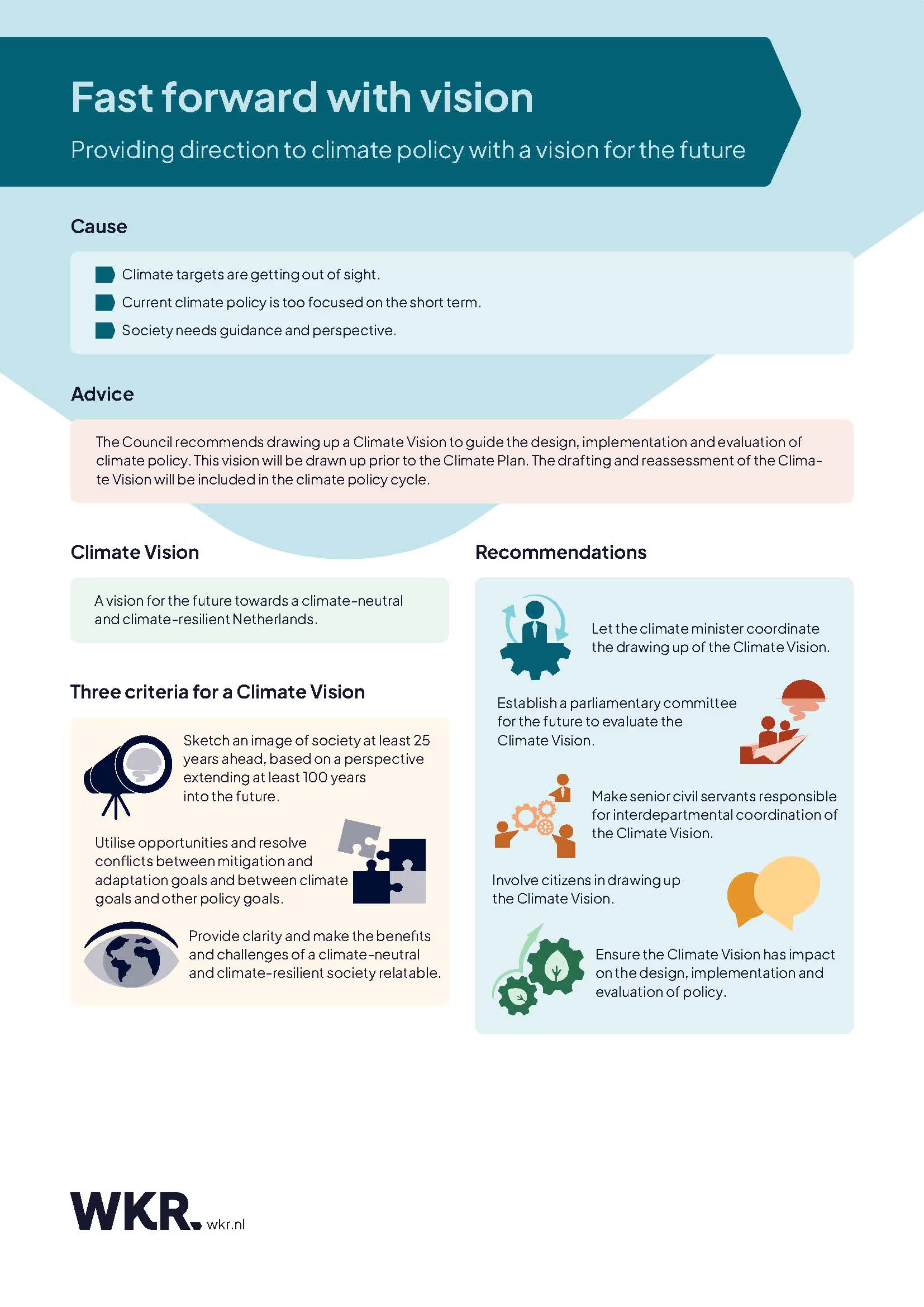
Image: © WKR
Recommendations
The WKR makes the following five recommendations to achieve a Climate Vision that contributes to long-term climate policy and is incorporated into the climate policy cycle:
- Give the minister with responsibility for climate policy a coordinating role in drawing up and re-evaluating the Climate Strategy
- Set up a parliamentary committee for the future that will critically evaluate the Climate Strategy and monitor it to ensure its coherence with strategies for the future of other policy domains.
- Set up an interdepartmental working group under the responsibility of senior civil servants to draw up the Climate Strategy and coordinate with other departments and administrative levels.
- Have the coordinating minister involve citizens in drawing up the Climate Strategy, in order to reflect the concerns of society, do justice to diversity and contribute to a broad support base.
- Ensure that the Climate Strategy carries through into the design, implementation and evaluation phase of climate policy and other related policy.
Impact on policy
Finally, better safeguards are needed to ensure that visions for the future are reflected in policy. In order to contribute to consistent long-term climate policy, a vision for the future must be reflected in all phases of the policy cycle. Many existing visions are not part of a policy cycle, but have been drawn up on a one-off basis without a clear plan for follow-up. As a result, their impact on long-term policy is not guaranteed. Some visions are legally guaranteed, which strengthens their impact on policy, such as the Environmental Vision.